5 Surprising Truths About Those Little Bumps on Your Aligners 😮✨
Those small, tooth-colored “bumps” aren’t just there for show — they’re intentional pieces of invisible engineering. Discover what they are, why they’re used, and how they make your clear aligner therapy work more predictably.
1. Not All Bumps Are the Same: Attachments, Buttons, and Bite Ramps
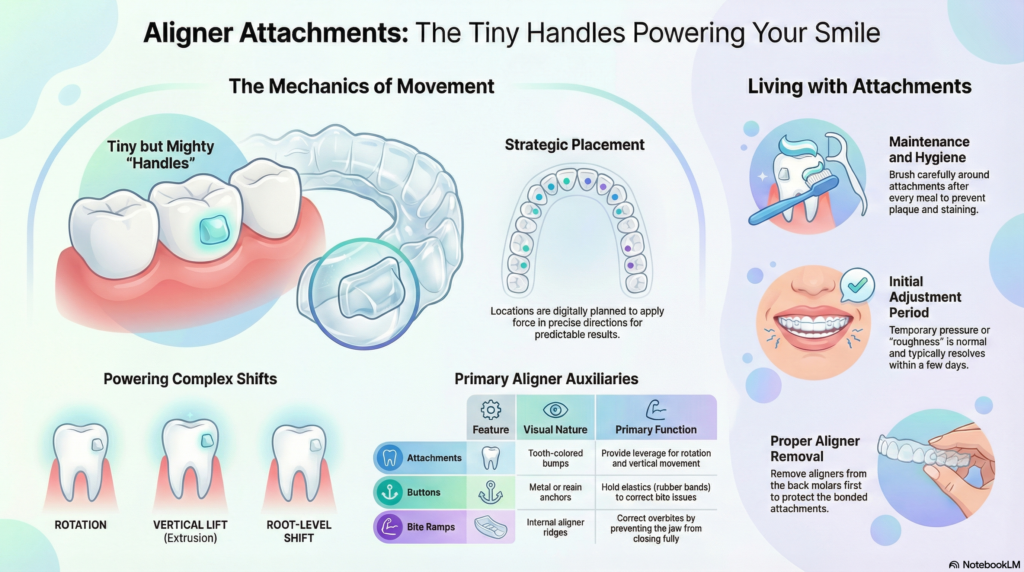
The everyday word “bumps” actually hides three distinct tools, each engineered to solve a different biomechanical challenge in your aligner treatment:
- Attachments (For Tooth Grip) — These are tiny, tooth-colored composite “handles” custom-bonded to your teeth. They give the aligner something precise to grip, allowing for complex forces and rotations.
- Buttons (For Jaw Alignment) — Small, often metal or clear, buttons bonded to specific teeth. They serve as anchor points for elastics (rubber bands) used to correct the relationship between your upper and lower jaws.
- Bite Ramps (For Bite Correction) — Unlike attachments or buttons, these are built directly into the aligner itself, usually behind your front teeth. They guide your bite, often used to help correct a deep bite.
2. Placed with Digital Precision — Not Everyone Needs Them
Attachment placement isn’t random; it’s meticulously planned during your digital treatment setup. They are applied selectively to teeth that require very specific, controlled forces — like rotations, vertical movements, or intricate root control. More attachments don’t necessarily mean better treatment; thoughtful, strategic placement is key.
“Thoughtful attachment placement is a hallmark of careful and effective treatment planning.”
3. Solving the “Traffic Cone Problem” — Enabling Rotation
Clear aligners primarily exert a pushing force. On naturally round or conical teeth, a smooth aligner tray can easily slip, much like one traffic cone might slide over another. Attachments provide the aligner with a flat, textured surface to effectively grab onto, allowing it to apply rotational force predictably and precisely, guiding your teeth into their correct positions.
4. Transforming Trays into a Powerful Orthodontic System
By acting as essential leverage points, attachments enable aligners to perform a range of complex tooth movements that were once primarily limited to traditional braces:
- Precise rotations of severely misaligned teeth.
- Controlled vertical changes, including intrusion (pushing teeth in) and extrusion (pulling teeth out).
- Bodily movement that shifts the entire tooth, including the root, rather than just tilting the crown.
Consider this analogy: Attachments are like the sails on a sailboat – they are expertly angled surfaces that catch the aligner’s push, translating that energy into precise, guided movement across the dental arch.
5. “Optimized” Doesn’t Always Mean Clinically Superior
Many proprietary, specially-shaped attachments are heavily marketed as advanced innovations. However, numerous clinical reviews and studies consistently show that there is no large, consistent advantage over well-designed and precisely placed conventional attachment shapes. The true drivers of successful treatment often boil down to the overall treatment plan and the skill of your orthodontist, rather than just marketing names or brand-specific features.
Quick Takeaways for Your Treatment
- Those small bumps on your aligners are sophisticated engineering, not merely decorative elements.
- They are deliberately chosen and positioned to address specific biomechanical challenges unique to your teeth.
- Don’t hesitate to ask your orthodontic provider for a clear explanation of why specific attachments are part of your personalized treatment plan.
Thought-Provoking Questions to Ask Your Orthodontist
- What specific types of “bumps” will be used in my treatment – attachments, buttons, or bite ramps?
- Could you explain the biomechanical reason why these are chosen for my specific teeth?
- Will the placement or type of these features change as my treatment progresses?